December 18, 2025

10
min read
Emergency Orders for Coal Plants: What the Power Crisis Means for Your Electric Bill


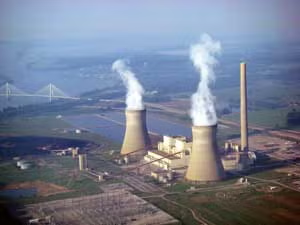
The Trump administration is now invoking emergency authority to prevent coal-fired power plants from retiring. This unprecedented move signals a deepening electricity crisis that's already driving up commercial electric bills across the United States, particularly in Indiana.
Energy Secretary Chris Wright recently testified that the national power supply crisis "keeps him up at night." His concern is justified. Nine of thirteen U.S. regional power grids have dropped to dangerously low capacity reserves, triggering reliability warnings and emergency interventions.
The Department of Energy has already issued emergency orders to keep a Michigan coal plant and a Pennsylvania oil-gas generator operational because grid reliability has become more critical than political optics. Wright's congressional testimony painted an even grimmer picture of where this crisis is heading, and his full warning is worth reading if you want to understand what's coming next for commercial ratepayers.
Approximately 8.1 gigawatts of coal capacity roughly 5% of the U.S. coal fleet was scheduled for retirement in 2025. These power plants weren't closing due to mechanical failure. They were being shut down to meet policy objectives, regardless of whether replacement capacity could maintain grid reliability.
The fundamental problem is straightforward: renewable energy sources cannot provide dispatchable power on demand.
Energy Secretary Wright explained to Congress that utilities have been incentivized for decades to build intermittent renewable resources without ensuring sufficient firm capacity backup. The result is predictable: as intermittent generation increases without adequate firm capacity, storage, and transmission infrastructure, electric rates climb dramatically.
The North American Electric Reliability Corporation (NERC) hasn't minced words about the severity of capacity constraints. Market analysts are forecasting price spikes and blackout risks for commercial and industrial customers as spare capacity margins continue to shrink.
These warnings carry specific implications for businesses that depend on uninterrupted power. NERC's detailed blackout warning breaks down exactly which regions face the highest risk and what manufacturers should be monitoring in their own service territories.
Indiana commercial electricity customers are experiencing the local impact of this national grid crisis through NIPSCO's aggressive rate increase schedule:
This dramatic escalation would have been unthinkable under traditional utility planning models. It represents the direct cost of retiring proven baseload generation before replacement resources can reliably serve demand.
NIPSCO's Integrated Resource Plan commits to a complete net-zero portfolio by 2040. This requires retiring existing baseload coal generation, replacing it with solar, wind, and battery storage systems, and maintaining natural gas backup for reliability during peak demand.
The burden falls disproportionately on commercial and industrial customers. Current cost allocation analysis shows residential customers pay approximately 78% of their actual cost of service, while some manufacturers on NIPSCO Rate 624 pay up to 133% of cost of service.
This isn't abstract accounting it shows up as real money on your monthly invoice. If you're wondering how exposed your specific facility is to these increases, this calculator lets you model the financial impact based on your actual consumption patterns and rate class.
Federal policymakers want to attract data centers, semiconductor fabrication facilities, aluminum smelters, and advanced manufacturing to the United States. These industries require one critical input: reliable, dispatchable electricity.
But when grid reliability is dismantled before replacement capacity proves functional, the system responds predictably:
This is no longer a future scenario, it's the current operational reality across multiple U.S. regional grids.
The same reliability risks driving federal emergency orders are already affecting Indiana's grid planning. For manufacturers, this creates dual exposure: escalating electricity rates to fund grid transition, plus operational risks from power quality degradation.
Power quality issues carry measurable financial impacts beyond the rate schedule. Manufacturers experience costs from production interruptions, equipment damage from voltage sags and harmonics, lost production time during grid instability events, and increased maintenance requirements on electrical systems.
Most facility managers underestimate these costs because they're not itemized on the utility bill. The actual business impact extends far beyond your kilowatt-hour charges. Understanding the full scope of power quality risks reveals why reliability matters as much as rates.
A single major outage can devastate quarterly financial performance for energy-intensive operations. Before dismissing this as unlikely, calculate what a power failure would actually cost your facility based on your production schedule and margin structure.
Commercial customers are absorbing massive cost increases to recover NIPSCO's renewable energy acquisition expenses. These aren't temporary surcharges, they're permanent increases to base rates that compound over time.
The current rate structure forces commercial and industrial customers to pay more than their proportional share of grid costs. This subsidy mechanism transfers millions of dollars annually from businesses to residential ratepayers.
As NIPSCO retires baseload generation faster than replacement resources can maintain reliability, commercial customers face growing exposure to grid instability during peak demand periods, potential curtailment during supply shortages, and higher real-time pricing during scarcity conditions.
Many commercial customers treat utility bills as fixed operational expenses beyond their control. This represents a strategic error that costs millions in unnecessary payments.
Utility rate increases are approved through contested regulatory proceedings where commercial customers have legal standing to intervene. These are not automatic approvals. They are adversarial processes where cost allocation assumptions can be challenged, capital recovery schedules can be scrutinized, reliability planning decisions can be questioned, and alternative rate structures can be proposed.
Commercial ratepayer groups that consistently participate in regulatory proceedings accomplish two critical objectives: immediate rate relief through reduced approved increases compared to utility requests, plus long-term behavioral change as utilities modify planning when they know informed customers will demand accountability.
This engagement doesn't require activism or political advocacy. It requires accurate data on your facility's electricity consumption patterns, expert testimony on utility cost recovery practices, and sustained participation across multiple rate case proceedings.
The mechanics of effective intervention aren't intuitive to most commercial customers. Understanding how utility rate management solutions work reveals why structured approaches consistently outperform ad-hoc responses, and examining actual case studies shows the specific tactics that deliver results in Indiana regulatory proceedings.
When the federal government requires emergency authority to keep power plants operational, the message to utilities is clear: commercial customers need informed advocates to keep electric rate increases accountable.
The grid capacity crisis is not approaching it has arrived. The rate increases are not proposed they are approved and being collected. The only variable under your control is whether you treat electricity as an uncontrollable expense or as a cost that responds to informed, strategic engagement.
Commercial and industrial electricity customers in Indiana face a critical decision window. NIPSCO's rate trajectory indicates continued escalation as the utility funds its net-zero transition. Each rate case that proceeds without effective commercial intervention locks in higher costs for years.
Understanding your vulnerability requires analyzing current electricity consumption patterns and rate classification, exposure to upcoming rate case proceedings and cost recovery schedules, power quality risks and potential outage financial impacts, plus strategic options for intervention and rate structure optimization.
Tactical Energy Group specializes in helping commercial ratepayers navigate utility rate proceedings, quantify grid reliability risks, and develop strategic responses to NIPSCO's rate increase trajectory.
Visit tac-nrg.com or schedule a consultation to evaluate your facility's options before the next rate case approval makes these costs permanent.
Key Takeaways: Coal Plant Crisis and Commercial Electric Bills
Read the full article at:
https://www.zerohedge.com/markets/white-house-plans-emergency-orders-keep-coal-plants-running-power-bill-crisis-emerges (widely circulated market reporting)
The federal government is issuing emergency orders because multiple U.S. power grids no longer have enough spare capacity to reliably meet electricity demand. As coal plants retire faster than replacement resources can provide dispatchable power, grid operators face increased risks of blackouts, price spikes, and industrial curtailment. Emergency authority is being used to prevent reliability failures that could disrupt businesses and households.
2. How do coal plant retirements increase commercial electric bills?
Retiring coal plants without sufficient replacement capacity forces utilities to rely on higher-cost power sources, emergency generation, and grid stabilization measures. These costs are passed directly to commercial and industrial customers through higher base rates, capacity charges, and fuel adjustment mechanisms. Over time, this leads to sustained electric rate increases rather than short-term volatility.
3. Why are Indiana commercial customers seeing much higher electricity rate increases?
Indiana commercial customers are experiencing outsized rate increases due to a combination of rapid grid transition costs and cost-of-service allocation policies. Utilities recover large capital investments in renewable infrastructure through rate cases, and commercial customers often pay more than their proportional share to subsidize residential rates and fund new generation assets. This results in compounding electricity cost increases for manufacturers and large energy users.
4. What can commercial electricity customers do to manage rising power costs?
Commercial electricity customers have legal standing to participate in utility rate proceedings where electric rates are approved. By engaging in these regulatory processes, businesses can challenge cost allocation methods, scrutinize capital recovery requests, and advocate for reliability-focused planning. Strategic participation has been shown to reduce approved rate increases and improve long-term cost outcomes.